
The Truth About Trading
People often ask how many traders make money as if trading were one activity. It is not. The odds look different depending on whether the person is holding a position for months, trading swings over several days, scalping intraday moves, or using leveraged over the counter products such as CFDs and margin forex. Product structure matters. Costs matter. Leverage matters. So does simple market microstructure. A trader fighting for a few basis points intraday is playing a different game from someone holding a broad trend for three months. That sounds obvious, but it gets lost once all of it is bundled into social media talk about “trading.” The result is that people compare outcomes across styles that are not really comparable.
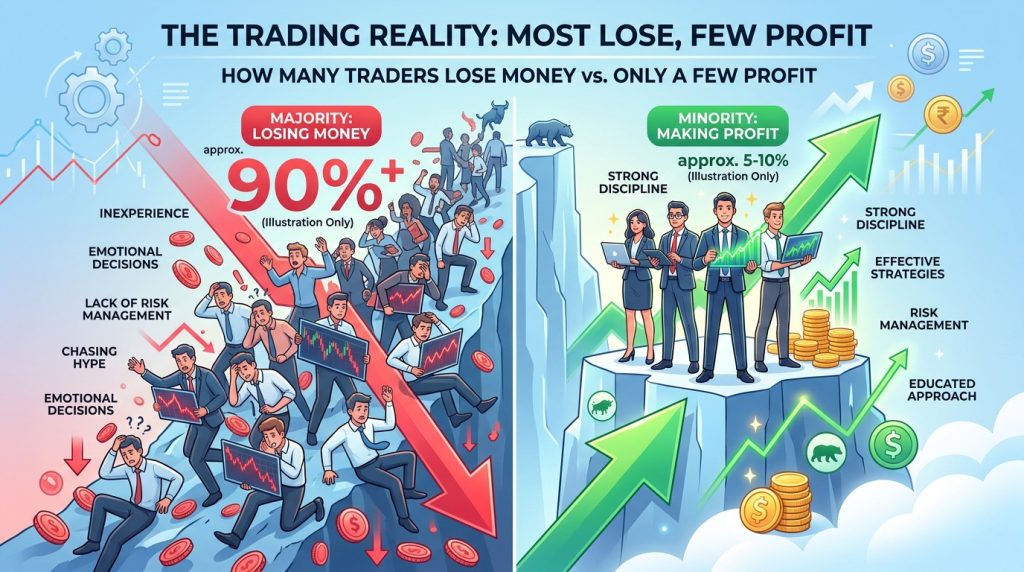
There is also a second problem. Many of the cleanest public numbers come from the parts of trading regulators monitor closely, especially leveraged retail products. That is why statistics for CFDs are easier to find than statistics for ordinary swing trading in cash equities. Regulators force disclosures where harm is common. Academic studies fill in part of the rest, especially for day trading. Taken together, the picture is not cheerful. A minority of active traders do make money, and an even smaller minority do so consistently over time. But most retail traders in the faster or more leveraged forms of trading lose money after costs. The exact percentage changes by market and product, though the direction of travel does not.
Position Trading and Trend Following
Position trading sits closest to traditional investing, though the intent is different. The trader is usually trying to capture a medium or longer move based on macro themes, valuation shifts, earnings trends, or broad technical structure. Trades may last weeks or months. Trend following is a related style, sometimes discretionary and sometimes systematic, where the idea is to stay with a move until price action says it has ended. Because turnover is lower, this type of trading suffers less from spread and commission drag than high frequency retail trading. It also gives the trader more room to be approximately right rather than perfectly precise. That helps. Markets are not generous, but they are a bit less hostile when you stop paying the toll booth every ten minutes.
The hard part is that lower frequency does not automatically mean easy profits. Position traders still face behavioural mistakes, late entries, oversized conviction, and the habit of turning a trade into an “investment” once it goes wrong. Academic evidence on individual investors broadly points in the same direction: heavy trading tends to reduce net returns, and the more actively individuals trade, the worse the average outcome becomes. That does not prove all position traders fail. It does suggest that slowing down helps by removing some sources of self inflicted damage. Whether that produces consistent profits depends on process, discipline, and a willingness to sit through boredom without manufacturing extra trades. Not glamorous, which is probably part of the problem.
How many make money with this style is hard to pin down in a clean public statistic. There is no universal registry for “position traders.” Still, compared with day trading and leveraged OTC speculation, longer holding periods usually give retail traders a better chance of avoiding fee drag and noise trading. That is not the same as saying most position traders are profitable. It is saying the structure is less punishing than very short term trading. In plain English, the game is still difficult, but at least the floor is not moving quite as fast.
Swing Trading
Swing trading usually means holding a position for several days to several weeks, trying to catch a move inside a larger trend or a short term reversal. For many retail traders this is the most plausible active style because it does not demand constant screen time and does not force entries and exits inside the noisiest part of the trading day. It sits in the middle ground. That middle ground is why it sells so well in courses and chat rooms, but it is also why people overestimate how easy it is. A swing trader still has to deal with timing, position sizing, earnings gaps, overnight risk, and the tendency to confuse “I have time” with “I can ignore risk.”
There is less formal profitability data for swing trading as a standalone category than for day trading or CFDs. Public regulator disclosures usually group retail losses by product, not by holding period. So there is no trustworthy universal figure like “x percent of swing traders make money.” What can be said is that swing trading avoids some of the harshest microstructure problems of scalping. It does not need ultra low latency, it is less exposed to tiny spread changes, and it gives setups more time to work. That improves the odds relative to rapid fire intraday activity, though it does not turn the activity into a comfortable income stream for most participants.
The usual failure mode is not that swing trading is mathematically impossible. It is that many traders gradually convert swing trading into frequent trading. They start with a multi day plan, then react to every intraday wobble, add leverage, widen stops after the fact, and pile on more positions than the account can sensibly carry. Once that happens, the apparent calm of swing trading disappears and the trader gets most of the disadvantages of day trading with fewer excuses. So yes, some traders make money swing trading, quite possibly a higher share than in day trading, but there is no good evidence that a majority do. The available research on individual trading behavior suggests caution rather than optimism. You can learn more about Swing Trading by visiting SwingTrading.com
Day Trading and Scalping
Day trading is where the public conversation gets loud and the numbers get ugly. Here positions are opened and closed within the same day. Scalping pushes this further, sometimes to minutes or seconds. The attraction is clear enough. No overnight risk, frequent opportunity, quick feedback, and the fantasy that skill can be compounded many times a day. The trouble is that the trader is now operating in the part of the market where costs, noise, execution, and competition matter most. The edge, if any, has to be both real and immediate. That is a narrow place to live.
Academic work on individual day traders is fairly consistent. Barber, Lee, Liu, and Odean’s Taiwan research found that day traders as a group lose money, while a relatively small group shows persistent ability. Their later work on the cross section of speculator skill also found that a subset of traders has genuine skill, but that this group is small relative to the broader population of participants. So the simplistic claim that nobody can make money day trading is not quite right. The correct statement is harsher and more useful: a small minority can, most cannot, and it is very hard to know in advance which camp a new trader belongs to.
The Brazil evidence is even more blunt. The study “Day Trading for a Living?” examined individuals beginning day trading in Brazilian equity futures and found that among those who persisted for more than 300 days, 97% lost money. Only 1.1% earned more than the Brazilian minimum wage, and just 0.5% earned more than the initial salary of a bank teller. That is not a rounding error away from success. That is a very narrow profitable tail. The paper’s conclusion is plain enough: it is virtually impossible for individuals to day trade for a living, contrary to what course sellers often imply.
That does not mean every profitable day trader is a myth. It means profitability is highly concentrated. A few skilled traders may have repeatable edges in liquidity provision, short term information processing, or specific setups they understand better than the field. The trouble for retail participants is selection. People do not enter day trading because they know they are in the top percentile. They enter because the activity is accessible, stimulating, and heavily marketed. That creates a crowd in which a small minority may genuinely win while the majority subsidises the lesson. A rather expensive classroom, when you put it that way.
So how many make money with day trading and scalping? The best answer from published evidence is: some do, but the share is small, and sustained full time profitability is smaller still. The more the style depends on speed, repetition, and tiny margins, the less forgiving it becomes. Retail traders often imagine that shorter time frames offer more opportunity because there are more price moves. In practice, they often offer more chances to pay costs and make mistakes. The market is very happy to provide both.
You can learn more about day trading by visiting DayTrading.com.
Leveraged OTC Trading: Forex, CFDs, and Similar Products
Retail leveraged trading through CFDs, spread bets, and margin forex produces the clearest modern loss statistics because regulators require firms to disclose them. The numbers are consistently bad. The FCA has said approximately 80% of customers lose money when investing in CFDs. Its more recent materials continue to repeat that figure when warning about CFD risks and financial promotions. ESMA’s earlier pan European work found that 74% to 89% of retail accounts typically lose money on CFDs, with average losses per client ranging widely across jurisdictions. These are not academic estimates from a single market many years ago. They are regulator level findings used to justify intervention measures.
ASIC’s January 2026 report adds a fresh data point from Australia. In financial year 2023 to 2024, 133,674 retail clients lost money trading CFDs, with net losses exceeding A$458 million, including A$73 million in fees. That tells you two things at once. First, the losing majority is not a stale story from one old cycle. Second, costs matter a lot. A trader does not just need to be directionally right. The trader must overcome leverage drag, financing, spreads, and the very human habit of turning a flexible product into a machine for repeated mistakes.
Forex trading in the retail sense often overlaps heavily with this world, because many retail forex trades are conducted OTC through brokers acting as counterparty or intermediary rather than on a central exchange. The product can be legitimate and the broker regulated, but the economics are still hard on the client. High leverage amplifies every error. Frequent trading magnifies costs. Holding trades incurs financing. Marketing often emphasises flexibility and access while underplaying how narrow the path to consistent profits really is. That is why retail forex discussions so often sound more hopeful than the public outcome data would justify.
How many make money here? Public warnings imply the answer is roughly one in five or worse for CFDs, and in some jurisdictions closer to one in four or one in six depending on the provider and period. That does not mean those traders are all making stable income; it usually means their accounts were profitable over the disclosure window. Sustained long term success is a tougher standard. The cleanest lesson is not that leveraged OTC trading is impossible. It is that it is one of the worst places to assume you are average and still expect a good outcome. Average is usually underwater.
Options, Futures, and More Specialised Trading
Listed options and futures sit in a different category from retail CFDs, but they are not a friendly shortcut to easy profits. They are exchange traded, centrally cleared, and generally cleaner in structure than many OTC retail products. That helps. It removes some counterparty and marketing problems. It does not remove leverage, complexity, or the need for actual skill. Options traders must think about volatility, time decay, skew, and position structure. Futures traders must think about contract mechanics, leverage, roll, and margin discipline. In other words, the product stops lying to you in one way and starts testing you in several others.
Public profitability figures for retail listed derivatives are less standardised than CFD disclosures, so broad statements need caution. Still, the same logic applies. Shorter horizons, more leverage, and higher turnover generally push the odds down. The Taiwan futures study from 2020 found that day trading in futures makes it difficult for individual traders to obtain superior performance, which fits the broader pattern from equity day trading research. Skilled minorities exist, but the activity is unforgiving, and the profitable share is small once costs are included.
For traders with basic knowledge, the mistake is often assuming listed products are safer because they are more legitimate. They are more legitimate in market structure terms, yes. They are not easier in performance terms. A listed contract can still hurt you very efficiently. Respectably, even.
Why So Few Traders Make Money Consistently
The short answer is costs, leverage, behaviour, and competition, though none of those are really short once you live through them. Transaction costs eat frequent traders. Financing charges eat leveraged swing traders. Overconfidence increases turnover, and research on individual investors has repeatedly linked more trading with worse outcomes. Then there is simple competition. A retail trader is not just trading against other people with chart apps. In many markets the other side includes institutions, professionals, and firms with better tools, better data, and fewer mistakes. That is not fatal by itself, but it does make “I will just out hustle them from my phone” a slightly shaky business plan.
Another reason is survivorship bias. The public sees traders who remain visible, not the many who quit quietly after losing money. This distorts perception. The profitable minority posts screenshots, sells subscriptions, or simply stays around long enough to be noticed. The losing majority gets a job, changes strategy, or stops talking. That makes trading look more populated by winners than it really is. Academic day trading studies are useful partly because they see the exits as well as the survivors. The resulting picture is much less flattering than the industry sales pitch.
The last point is that “making money” is often measured too loosely. A profitable month is not the same as a durable edge. A positive account over a disclosure period is not the same as a living. A trader may make gross profits and still fail after commissions, spreads, taxes, and variance are considered. This is why the small profitable minority in academic work matters more than motivational slogans. It shows that skill can exist, but it also shows how rare it becomes after the market sends the bill.
Closing
Different types of trading produce different odds, but the broad pattern is clear. The longer term, lower turnover styles are generally less punitive than rapid fire or heavily leveraged ones. Day trading has a small profitable minority and a large losing majority. Retail CFDs and similar leveraged products produce regulator reported loss rates that are usually around three quarters to four fifths of clients. Some traders do make money. The mistake is assuming that “some” means “many,” or that activity itself is evidence of skill. In trading, frequency often raises confidence faster than competence. The market notices the difference.