
Risk of Forex Trading
Forex trading is often sold as simple. The market is liquid, the instruments are familiar, and the currency pairs look less intimidating than many derivatives. That is the sales version. The actual retail version is a leveraged, over the counter business where the trader’s result depends not only on market direction but also on costs, execution, financing, discipline, and the quality of the firm sitting on the other side of the screen. The risk is not one thing. It is a stack. Leverage turns small price moves into large account swings. Frequent trading turns modest spreads into serious drag. Weak broker controls can turn a hard activity into a crooked one. So the question is not whether forex is risky. It clearly is. The better question is which parts of the risk come from the market and which parts come from the product and counterparty structure.
For traders and investors with basic knowledge, there are three separate issues to keep apart. The first is whether most retail forex traders make money. The second is whether a given broker model creates conflicts with the trader. The third is whether the firm is genuine at all. These issues overlap, but they are not the same. A lawful broker can still offer a product that most clients lose money on. A broker with lower conflict can still be expensive. A fake broker can copy the language of both. That is why the usual online argument, market maker bad, ECN good, misses a chunk of the real picture. The market itself is already difficult. Broker type can improve or worsen the odds around cost and conflict, but it does not turn leveraged retail forex into an easy game.
Visit ForexBrokersOnline.com if you want to know more about different types of brokers and review reviews about individual Forex Brokers.
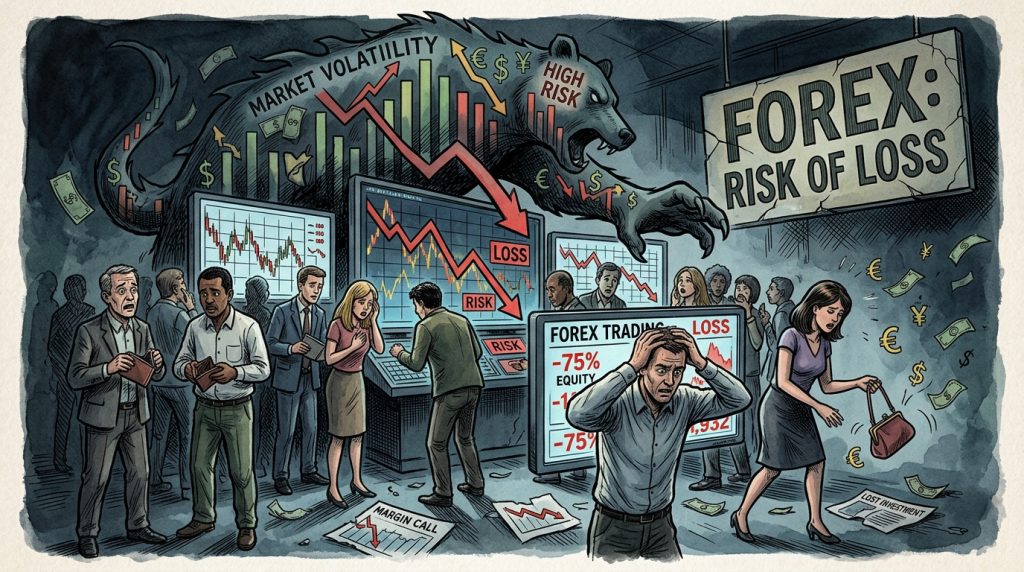
How retail forex actually works
In retail forex, the trader is usually not accessing a central exchange in the way people often imagine. U.S. rules on off exchange foreign currency transactions state that the trading platform a retail customer uses is connected only to the futures commission merchant or retail foreign exchange dealer. The customer is using that platform to transact with the dealer, not with other customers of the dealer and not with a public central order book. NFA describes a Forex Dealer Member in similar terms: it acts, or offers to act, as a counterparty to an off exchange foreign currency transaction with a retail customer. That point matters because it answers a lot of basic confusion. Many retail forex relationships are direct contractual relationships with a broker or dealer, not anonymous exchange matching.
That structure does not automatically mean the broker is a scam. It means the broker’s role is bigger than many traders assume. In some cases the firm acts as principal and takes the other side of the trade. In others it may route or offset flow externally. In practice many firms do a mixture, depending on size, client type, and internal risk management. The trader sees a chart and a buy button. Behind that sit pricing choices, spread policy, financing charges, and execution methods that shape the real economics of the trade. The legal setup is not background detail. It is part of the product.
This is one reason the risk of forex is easy to understate. A trader may believe they are mainly taking a view on EUR/USD or USD/JPY. In reality they are also taking a view on the broker’s pricing, on their own ability to handle leverage, and on the chance that costs over time will eat the account faster than skill can rebuild it. That is before we even get to fraud, which is a separate layer again. CFTC has been warning the public for years to research OTC forex thoroughly, stressing that the area attracts both high risk speculation and fraudulent dealers taking deposits without providing a fair market service.
The main risks of forex trading
Leverage is the first problem, not the second
Forex markets often move in increments that look small in percentage terms. That is why leverage is so central to the retail pitch. Without leverage, many short term moves would feel modest. With leverage, modest becomes account threatening very quickly. ASIC’s 2026 CFD sector report explains this cleanly: CFDs allow clients to speculate on price changes in assets including currencies, and leverage plus financing fees can magnify losses. The same logic applies to retail margin forex more broadly. A trader does not need a dramatic market collapse to lose meaningful capital. A small adverse move can do the job.
Leverage also changes trader behaviour. It encourages larger positions than the underlying cash account would otherwise support, which makes ordinary market noise harder to tolerate. The trader then cuts winners early, widens stops late, or adds to losing trades because the position size was too large to hold calmly in the first place. Those are not side effects. They are common mechanical consequences of offering too much exposure to an underprepared user.
Costs are smaller than losses until they are not
Spreads, commissions, overnight financing, slippage, and rollover costs do not look dramatic on a single ticket. Over time they become one of the main reasons retail traders struggle. FCA has repeatedly warned that CFDs are highly leveraged and that about 80% of customers lose money when investing in them. That figure is not just about bad predictions on direction. It reflects a product structure where repeated trading and leverage make it hard for average clients to stay ahead after all costs. In Australia, ASIC reported that in financial year 2023 to 2024, retail CFD clients lost more than A$458 million net, including A$73 million in fees. That fee component matters. It shows that even before considering behavioural mistakes, the meter is running.
For swing traders and intraday traders, this cost drag can be lethal. The strategy does not just need to be directionally right. It must be right enough, often enough, to overcome the toll of participating. In lower frequency investing, that toll is manageable. In leveraged OTC trading, it can be one of the main enemies.
Execution and platform risk are real even at lawful firms
Retail traders often talk about “the market” as if the price on screen were the whole story. It is not. Execution quality, stop handling, quote updates, and slippage policy all affect realised results. In retail OTC forex, these factors sit inside the broker relationship. That is one reason broker type matters, though not in a magical way. The platform is not a neutral window. It is part of the trade environment, and that environment can help or hurt the trader within lawful bounds.
Fraud risk sits on top of market risk
CFTC’s advisory on OTC forex says potential investors should thoroughly research the investment and warns that fraudsters posing as OTC forex dealers take deposits but do not follow through honestly. An older CFTC and NASAA investor alert put it even more bluntly, saying off exchange forex trading by retail investors is at best extremely risky and at worst outright fraud. Those warnings still matter because forex fraud does not always look like a ridiculous promise. Sometimes it looks like a normal broker website, a call from an account manager, or a social media ad offering a low minimum deposit and “guidance.”
This is an important distinction. Market risk means you were wrong or unlucky in a real market relationship. Fraud risk means the relationship itself may be fake, manipulated, or designed to prevent withdrawals. Traders often underestimate the second risk because they focus so heavily on charts.
How many retail forex traders make money
There is no single clean global statistic for “forex only” profitability because retail regulators usually disclose outcomes by product family, especially CFDs and similar leveraged OTC instruments, rather than by precise holding period or asset class. Since a large share of retail forex trading occurs through the same leveraged OTC broker ecosystem, those disclosures are still the best public guide to what happens to retail traders in practice. And the numbers are poor.
FCA said again in February 2026 that it has previously said 80% of customers lose money when investing in CFDs because of the risks. CFDs are not identical to every retail forex product everywhere, but the overlap is large enough that the figure is highly relevant to retail leveraged forex style trading. It tells you that the default retail experience in this product family is losing money, not making it.
ASIC’s January 2026 report gives another recent benchmark. It said that in the 2024 financial year, 68% of retail CFD investors lost money, with total losses above A$458 million including fees. That implies about 32% were profitable after fees over that period. Two cautions matter here. First, “profitable over the period” is not the same as “consistently profitable long term.” Second, these are sector level outcomes in Australia, not a universal law of nature. Even so, they point the same way as the FCA data: most retail participants in leveraged OTC trading lose money.
So how large a percent make money in retail forex. The most honest grounded answer is that a minority do, and in closely related leveraged retail products the profitable share is often around 20% to 32%, depending on jurisdiction, provider mix, and measurement period. That also means the losing share is commonly around two thirds to four fifths. Those numbers are much more useful than the vague old line that “ninety percent lose,” because they are tied to recent regulator data rather than folklore. They are still bad enough.
It is also worth noting what these figures do not prove. They do not prove that forex is impossible. They do not prove every losing trader was scammed. They do prove that the base rate is against the retail client. That should shape expectations. A newcomer should assume that average performance in this field is negative unless they have a specific reason, tested over time, to believe they are above average after costs. Harsh, but better than the motivational alternative.
Does the type of broker matter
Yes, but not in the way marketing suggests
Broker type matters because it affects conflicts of interest, pricing, and execution. It does not matter enough to rescue a trader from leverage, poor strategy, or overtrading. That is the right balance. Many online discussions swing between two bad extremes: either broker type is irrelevant, or broker type explains almost everything. Neither is true.
NFA’s definition of a Forex Dealer Member is a useful anchor. In the U.S. retail off exchange market, an FDM acts as counterparty to the transaction. That means a classic dealer or market maker structure. This is lawful and normal in that framework. It also means the firm has a built in conflict with the client on at least some trades, because it is standing on the other side. That does not automatically make it abusive. It does mean the trader should stop imagining the broker as a neutral friend whose only job is to “provide access.”
Dealing desk and market maker models
A dealing desk or market maker broker usually quotes prices to the client and may internalise risk rather than instantly offsetting every trade externally. The advantages can include consistent quoting, simple execution, and operational efficiency. The disadvantages are clear enough. The broker has more discretion over spreads and more commercial interest in client flow. If the broker keeps some exposure, client losses may benefit the firm directly before hedging and broader book management are considered.
This does not mean all dealing desk brokers are bad. It means the conflict is structural and should be acknowledged. In a regulated setting, that conflict is supposed to be managed through rules, supervision, capital requirements, and disclosure. In a badly run or offshore setting, the same structure can turn much uglier.
STP, ECN, agency style, and similar labels
Agency style labels such as STP and ECN are often presented as if they remove the conflict entirely. They usually reduce some conflicts, not all of them. If the broker routes your order onward and earns mainly from commissions or spread markup rather than from warehousing your directional loss, it has less reason to hope that your individual trade fails. That is a genuine improvement in alignment.
But the broker still benefits from activity. More trades mean more spreads, more commissions, more markups, more financing days, and often more chances to cross sell or upsell. So the conflict changes shape rather than disappearing. The broker may no longer be cheering every stopped out trade from the opposite side of the book, but it still has every reason to encourage frequent participation. For a retail trader, that can be almost as costly over time.
So does the model change trader outcomes
Potentially yes, through cost and execution quality. A broker with lower spreads, cleaner fills, less intrusive dealing intervention, and fewer adverse pricing practices can improve the trader’s net result at the margin. For active traders, that margin matters a lot. A strategy that barely survives at one cost level may fail at another.
Still, the sector level loss statistics should keep the discussion honest. Most retail clients lose money across the product family anyway. That means broker choice is important, but it is not a cheat code. Choosing a cleaner broker can reduce avoidable drag and reduce certain conflicts. It cannot manufacture an edge where none exists.
When the broker is not just conflicted but dangerous
There is a big difference between a conflicted lawful broker model and a fake or abusive operator. CFTC has warned that fraudsters posing as OTC forex dealers take deposits but do not provide a fair, lawful service. In those cases the problem is no longer spread size or execution style. It is whether the platform is genuine, whether prices can be manipulated, and whether withdrawals will ever be honoured.
A dangerous broker often shows the same pattern seen elsewhere in leveraged trading fraud. Grand claims about regulation, unclear legal entities, offshore structures, bonus offers, high pressure calls, and friction when money is requested back. The trader may spend weeks arguing about “verification” or taxes on profits while missing the more obvious point that a legitimate broker does not usually become inventive only when money is leaving. This is where type of broker matters in the most basic possible way: a fake broker is not a broker problem, it is a theft problem.
What traders should check before opening an account
Start with the legal entity and registration. NFA’s member resources on forex say only certain regulated entities may be counterparties to off exchange retail forex trades in the U.S. If a firm claims regulation, verify the exact entity directly, not through the broker’s own website alone. Then read how the firm says it executes. If it is the counterparty, that should be clear. If it routes externally, that should also be described in a way that makes sense.
Next, look at the economics. Spread, commission, financing, inactivity fees, and withdrawal practices tell you more than the homepage slogan. A broker that wins on social media aesthetics but loses on basic transparency is not offering anything useful. Finally, remember the loss rates. If a product category routinely produces losing outcomes for most retail clients, that should lower your confidence by default, not raise your appetite because you assume you will be the exception.
Closing
Forex trading is risky because the product combines leverage, cost, behavioural pressure, and broker dependence in one place. Most retail traders do not make money. Recent regulator evidence from closely related leveraged OTC products suggests the profitable share is often only around one fifth to one third over a given period, with the rest losing money. Broker type does matter because it affects conflict, pricing, and execution. But it does not change the basic fact that leveraged retail forex is a hard business for the client. A better broker can reduce damage. It cannot remove the risk or replace actual skill.