
How Most People Succeed at Long Term Investing
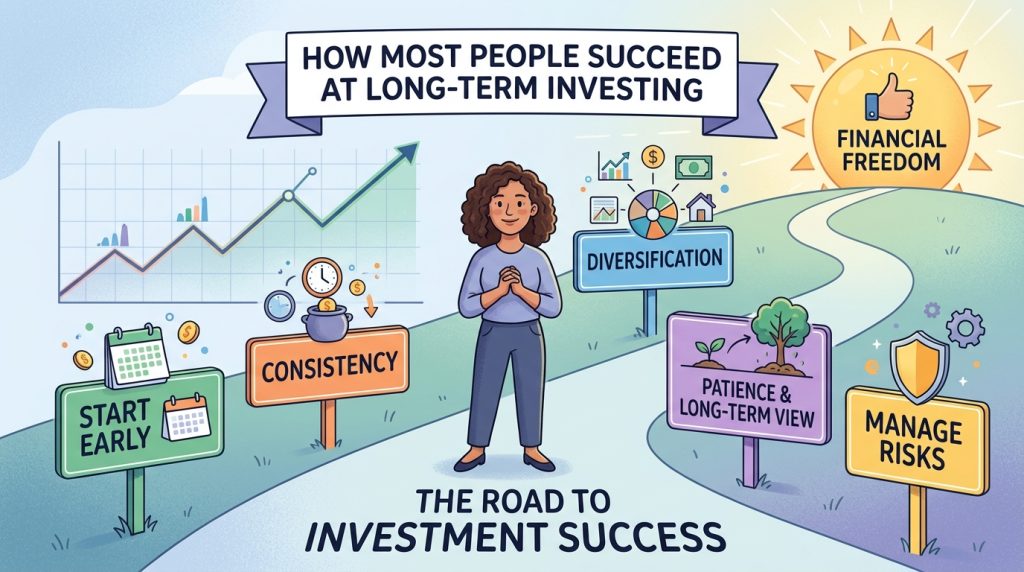
Most people who succeed at long term investing do not do it by forecasting the next hot sector, rotating in and out of markets, or building a heroic stock picking record. They usually do it in a much duller way. They save regularly, keep costs down, diversify widely, own enough stocks to generate growth, own enough safer assets to stay calm, and then avoid sabotaging the plan every time markets become unpleasant. That sounds simple because it is simple. It is not easy. The hard part is behaviour. The market supplies reasons to quit every few years, sometimes every few months.
For an investor with basic knowledge, the practical question is not whether stocks, mutual funds, or ETFs are “good” in the abstract. The real question is which securities are suitable for a long horizon, what return range is reasonable to expect, and what structure gives you the best chance of staying invested when conditions turn ugly. Suitability is not about excitement. It is about matching the investment to the job. Growth assets such as stocks are useful because long term goals usually require growth. Diversifying assets such as bonds are useful because people are not robots, and a portfolio that looks clever on paper but cannot be held in real life is not much use.
If you lack basic knowledge about investments then I recommend you visit Investing.co.uk and read their beginner’s guide before reading the rest of this article.
What Usually Drives Success in Long Term Investing
The SEC’s investor education material puts the starting point plainly: asset allocation depends largely on time horizon and risk tolerance. A longer horizon usually allows an investor to take more risk, because there is more time to recover from market declines. A shorter horizon usually calls for less risk. That idea is more important than stock picking for most people. If your horizon is twenty or thirty years, refusing to hold enough equities can be just as costly as taking too much risk. If your horizon is short, pretending you can shrug off a large drawdown is how people end up selling at exactly the wrong time.
Diversification is the next piece. Investor.gov says a diversified portfolio should be diversified both between asset categories and within asset categories. It also makes a useful point that many people miss: owning only four or five individual stocks is not really diversified, and an investor would generally need at least a dozen carefully selected individual stocks to be truly diversified within equities. That is still a fairly narrow portfolio compared with what a broad market fund gives you in one trade. This is why many people do better with pooled funds than with a hand built stock collection. The fund solves a diversification problem that individuals often underestimate.
Rebalancing matters too. FINRA notes that passive investors often rely on index funds and may rebalance periodically, such as annually, to bring the portfolio back to its intended asset mix. That sounds administrative, but it is really a behavioural control. Rebalancing stops a portfolio from quietly turning into something more aggressive or more conservative than the investor intended. It also forces discipline. You trim what has run ahead and add to what has lagged, instead of chasing whatever has recently looked smartest. Not thrilling, though it does save people from a fair amount of self inflicted nonsense.
Costs are the quieter driver of success. The SEC’s July 2025 bulletin says fees and expenses reduce the value of fund returns, and that a fund with higher costs must perform better than a lower cost fund to deliver the same result to the investor. Even small fee differences can turn into large differences over time. Long term investing is one of the few areas in finance where reducing what you pay is almost the same as increasing what you earn. You do not need a genius manager to be ahead of a more expensive version of the same exposure. You just need less drag.
Suitable Stocks for Long Term Investors
Stocks are usually the main growth engine in a long term portfolio. Investor.gov says stocks have historically had the greatest risk and the highest returns among the three main asset categories of stocks, bonds, and cash. That is why most financial experts think long term investors usually need at least some stock exposure. If your goal sits decades away, trying to reach it with cash alone is usually too cautious to be effective. The problem is not whether stocks belong. The problem is how to own them sensibly.
Individual stocks can be suitable in some cases. A patient investor with enough diversification, good cost control, and realistic expectations can own individual companies for many years. The trouble is concentration. A small portfolio of single names creates business risk, sector risk, and valuation risk that a broad market fund largely removes. For most people, that concentration is not compensated by superior skill. It is just extra uncertainty dressed up as conviction. That is why individual stocks are often best treated as a satellite position around a diversified core, not as the core itself.
Suitable stocks for long term investors are usually boring in the right way. Large, established companies with durable earnings, reasonable valuations, and long operating histories are easier to hold than speculative stories with fragile economics. But even then, a broad equity fund often does the job better because it spreads risk across hundreds or thousands of companies. The reason most people succeed through funds rather than direct stock portfolios is not that stock picking never works. It is that broad ownership is easier to sustain, harder to derail with one mistake, and less dependent on being unusually good at judging businesses. That last part is where many ambitious investors go slightly off the rails.
Mutual Funds and ETFs
Mutual funds and ETFs are suitable for most long term investors because they pool money and invest across many securities. Investor.gov says mutual funds may invest in a range of companies and industries, which helps lower risk if one company fails. Its ETF guidance says ETFs also pool investor money into a portfolio that can hold stocks, bonds, money market instruments, other assets, or a mix of them. That pooled structure solves the basic diversification problem at low operational effort for the investor. You do not need to buy dozens or hundreds of securities one by one. The fund does that for you.
The difference between mutual funds and ETFs matters less than many people think. Both can be suitable. Mutual funds are priced once a day after the market closes. ETFs trade intraday like stocks. For long term investors, that trading flexibility is often a minor feature rather than a major advantage. What matters more is what the fund owns, how broadly it diversifies, how it is managed, and how much it costs. An ETF with narrow, thematic exposure can be less suitable than a plain mutual fund tracking a broad stock index. The wrapper matters less than the substance.
For most investors, broad index funds are the default sensible option. FINRA says passive investors often rely on index funds because they can help with diversification, and passive investing is built around recreating market performance over time. That usually means lower turnover and lower fees than active management. Lower fees are not a side benefit. They are a large part of why indexing has worked so well for ordinary investors. When the goal is to capture market returns over decades, being consistently cheap is a stronger advantage than sounding clever.
Active funds can also be suitable, but they ask more from the investor. You need to judge whether the strategy is sound, whether the manager is skilled, whether the process will survive personnel change, and whether higher fees are justified. The historical evidence is not especially generous here. S&P Dow Jones Indices’ SPIVA U.S. Year-End 2025 report found that 79% of active U.S. large cap funds underperformed the S&P 500 in 2025, while 70% of bond managers underperformed across bond categories on average. SPIVA also notes more broadly that relatively few active managers outperform passive benchmarks over either short or long periods. That does not mean active management is impossible. It means choosing the winners ahead of time is harder than the sales pitch suggests.
Fees strengthen the case for broad low cost funds. The SEC’s 2025 bulletin says operating expenses are deducted from fund assets and reduce investor returns, and that higher cost funds must outperform lower cost funds just to end up equal after fees. That arithmetic becomes very important over twenty or thirty years. A fund does not need to be outrageously expensive to be a drag. Modest annual differences compound. So when people ask how most investors succeed, one honest answer is that they avoid paying too much for products that are trying to solve a problem already solved by a plain index fund. Not glamorous, but financially quite useful.
Bonds, Bond Funds, and the Role of Cash
Bonds and cash usually do not make a portfolio richer over very long periods than equities do, but they often make it holdable. Investor.gov says stocks have historically offered the highest return potential, while cash equivalents are generally the safest and lowest returning of the major asset categories. Bonds sit in the middle. Their job is not usually to win the race. Their job is to reduce volatility, provide income, and give the investor something steadier to rebalance from during equity drawdowns.
That makes bonds suitable for investors with shorter horizons, lower tolerance for drawdowns, or a practical need to stabilize portfolio value. Bond funds and bond ETFs are often more suitable than individual bonds for smaller investors because they provide diversification across issuers and maturities. Cash also has a role, especially for near term spending needs or emergency reserves, but it is generally a poor long term growth asset. Investor.gov says that if you do not include enough risk in a portfolio, it may not earn enough to meet long term goals. For retirement style horizons, that usually means some meaningful stock allocation is needed even if bonds and cash are part of the mix.
Historical Returns and What They Do and Do Not Mean
Historical returns are useful because they show what different asset classes have done across wars, recessions, inflation shocks, and long market cycles. They are dangerous when treated as promises. The UBS Global Investment Returns Yearbook 2025 reports that from 1900 through 2024, U.S. equities returned 9.7% annualized in nominal terms, versus 4.6% for long bonds, 3.4% for Treasury bills, and inflation of 2.9% per year. In real terms, the same Yearbook says the average annual real return on government bonds across 21 continuous-history markets was 0.9%, while in an average year the real return on U.S. equities was 8.5%. Those are powerful long run numbers, but they came with severe volatility and long stretches of disappointment.
The same Yearbook also notes that since 2000, global equity investors still earned an annualized real return of 3.5%, even though stock returns in the 21st century have been lower than in the 20th. That is a useful reminder. Long term investing works partly because time smooths things out, but not perfectly and not on a schedule that feels polite. A ten year period can look wonderful or miserable depending on where it starts. People say they are investing for the long term, then discover that the long term is longer than expected. Markets do enjoy that little joke.
Historical returns also need to be read in real, not just nominal, terms. FINRA notes that inflation matters when evaluating long held investments because it reduces the purchasing power of money over time. A nominal return that looks respectable can be mediocre after inflation. That is one reason equities have played such a large role in long term wealth building. Their volatility is unpleasant, but their real return history has been much stronger than that of cash and, over very long periods, stronger than that of government bonds.
Expected Returns From Here
Expected returns are not historical averages repeated mechanically. They reflect current valuations, yields, and starting conditions. Vanguard says its capital market forecasts are probabilistic, based on current conditions, and should not be treated as a reason for aggressive allocation changes on their own. Schwab’s 2026 long term capital market expectations give a clearer public snapshot: U.S. large cap equities are expected to return 5.9% annualized over the next decade, developed international large caps about 7.0%, U.S. aggregate bonds about 4.8%, and cash about 3.3%. Schwab also notes that U.S. equity expectations are lower partly because market prices rose faster than earnings expectations, while bond return expectations are better than the previous decade largely because starting yields are higher.
The practical implication is that investors should probably expect something more modest than the very strong U.S. equity experience many became used to in parts of the 2010s and early 2020s. That does not mean stocks are unsuitable. It means expectations should be adjusted. A diversified equity and bond portfolio can still be a sensible long term plan, but it should be built around realistic return assumptions rather than inherited market folklore. The old habit of plugging in a high single digit stock return and calling the plan done is looking a bit optimistic.
Closing
Most people succeed at long term investing by doing ordinary things well for a long time. They hold enough equities to grow, enough bonds or cash to stay invested, and they use broad mutual funds or ETFs to diversify cheaply. Individual stocks can be suitable, but usually as a supplement rather than the whole plan. Historical returns show why stocks matter. Current forecasts show why expectations should stay grounded. The formula is not mysterious. Broad ownership, low fees, steady saving, periodic rebalancing, and patience still do most of the heavy lifting.